
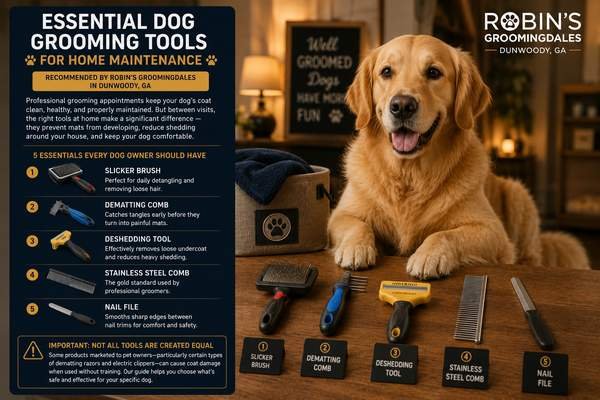
One of the most common questions we hear at Robin’s Groomingdales is: “What should I be doing at home between appointments?” The answer always starts with the right tools. Having the correct grooming equipment — matched to your dog’s specific coat type — makes home maintenance easier, prevents painful mats and tangles, and extends the results of every professional grooming session.
This guide covers the essential tools every Dunwoody and Sandy Springs dog owner should have at home, what each one does, and how to use them safely between your dog’s professional appointments.
Why the Right Tools Matter
Using the wrong brush or comb doesn’t just fail to help — it can actually cause damage. The wrong tool on the wrong coat can break hair, scratch skin, create static electricity that tangles fur further, or miss the undercoat entirely. After 35 years of professional grooming in Dunwoody, our team has seen the results of well-intentioned home grooming gone wrong.
The good news: you don’t need a salon full of equipment. A small collection of the right tools, used consistently, is far more effective than a drawer full of the wrong ones.
The 5 Essential Grooming Tools for Home Use
1. Slicker Brush — The Everyday Essential
A slicker brush is the most versatile grooming tool available and works for almost every coat type. It has a flat or slightly curved head with fine, short wire pins set close together. The pins are angled to penetrate the coat, remove loose hair, lift debris, and gently work through surface tangles.
Best for: Doodles, Poodles, Golden Retrievers, Spaniels, Shepherds, and most mixed breeds
How to use it: Brush in the direction of hair growth using light, short strokes. Work section by section from the skin outward. Never pull through a tangle — stop, hold the hair near the base to prevent discomfort, and work through the mat carefully from the ends inward.
How often: Most dogs benefit from slicker brushing two to three times per week. Double-coated breeds and Doodles may need daily brushing to stay mat-free.
2. Dematting Comb — Tangle Prevention Before It’s Too Late
A dematting comb has widely spaced, rotating teeth designed to work through tangles and early-stage mats without pulling excessively on the skin. This tool is the bridge between a slicker brush and calling your groomer.
Best for: Dogs prone to matting — Doodles, Poodles, Cockapoos, Shih Tzus, and any dog with a longer or wavy coat
How to use it: Work on one small section at a time. Hold the hair at the base to stabilize the skin, then work the comb gently through the mat from the outer edges inward. If a mat doesn’t yield after several gentle passes, stop — forcing it can cause pain and skin irritation. At that point, your groomer needs to assess whether the mat can be brushed out or must be clipped.
Important: Avoid dematting tools with blade-style inserts unless you’ve been trained to use them. These can cut skin or unevenly damage the coat.
3. Deshedding Tool — For Heavy Shedders
If your dog has a double coat — a dense undercoat beneath a longer topcoat — a deshedding tool removes loose undercoat that standard brushes miss. The most well-known version is the Furminator-style tool, which uses a fine-toothed metal blade to pull dead undercoat through the topcoat.
Best for: Labrador Retrievers, German Shepherds, Huskies, Golden Retrievers, Corgis, Border Collies, and other double-coated breeds
How to use it: Use gentle, short strokes in the direction of hair growth. Do not press hard — the tool works by weight and the teeth’s design, not pressure. Use for no more than 10–15 minutes per session to avoid skin irritation.
Critical note: Deshedding tools are not appropriate for single-coated breeds like Poodles, Doodles, Maltese, or Shih Tzus. On these dogs, they can damage the coat and irritate the skin. If you’re unsure whether your dog is double-coated, ask your groomer at Robin’s Groomingdales.
4. Stainless Steel Comb — The Professional’s Standard
A fine-and-wide stainless steel comb is what professional groomers actually use to check their work and finish a coat. One half has fine teeth for face, ears, and tight areas; the other has wider teeth for the body. It catches tangles the slicker brush may have missed and gives you a clear picture of the coat’s condition.
Best for: All coat types — this is the finishing and verification tool
How to use it: After brushing, run the comb slowly through the entire coat from skin to ends. If the comb snags or stops, there’s a tangle that needs attention. The comb should glide through a well-maintained coat with no resistance.
Pro tip: If your comb snags consistently in one area between appointments, that area needs more frequent brushing. Pay particular attention to behind the ears, under the collar, in the armpits, and where the legs meet the body — these areas mat fastest.
5. Nail File — Smooth Edges Between Trims
Between professional nail trims, a nail file helps smooth sharp edges after walks on pavement or concrete. This is especially useful for dogs whose nails grow quickly or who scratch floors and furniture with sharp nail tips.
Best for: All dogs, especially those with light-colored nails (easier to see the quick) or active dogs who spend time indoors
How to use it: Gently file in one direction along the bottom edge of each nail after your dog’s walk. Do not attempt to shorten the nail significantly with a file alone — nail trimming still requires proper nail clippers or a Dremel-style grinder, ideally done by your groomer. The file is for maintenance, not reduction.
Bonus: Tools to Avoid
Not every product on the pet store shelf is safe or effective. Based on our groomers’ experience, here are the tools that cause more harm than good in untrained hands:
- Electric clippers — Without proper training in line blending and guard combs, electric clippers create uneven lines, clipper rash, and can accidentally cut skin. Leave clipping to your professional groomer.
- Dematting razors with exposed blades — These single-blade dematting tools can cut skin, especially in skin-fold areas and on dogs who move suddenly. Not recommended for home use.
- Human scissors near the face or paws — Scissors near eyes, ears, and paws require training to use safely. Even a small flinch can cause a puncture or laceration. Trimming in these sensitive areas should be done by a professional.
- Pin brushes with hard tips — Low-quality pin brushes with sharp, uncoated metal tips scratch the skin surface, especially in short-haired breeds. Choose brushes with coated or rubber-tipped pins, or a quality slicker brush instead.
Matching Tools to Your Dog’s Coat Type
Here’s a quick reference by coat type to help Dunwoody and Sandy Springs dog owners choose the right tools:
- Curly / Wavy coats (Poodle, Doodle, Bichon): Slicker brush + dematting comb + stainless steel comb. No deshedding tool.
- Double coats (Lab, Shepherd, Husky, Golden): Slicker brush + deshedding tool + stainless steel comb. No dematting comb needed if brushed regularly.
- Silky / Flowing coats (Spaniel, Setter, Shih Tzu): Slicker brush + pin brush + stainless steel comb. Use dematting comb if prone to tangles.
- Short coats (Boxer, Beagle, Dalmatian): Rubber grooming mitt or bristle brush + stainless steel comb. Minimal tooling required.
- Wire / Terrier coats: Slicker brush + stainless steel comb. Some wire-coated breeds also benefit from a stripping comb — ask your groomer.
How Home Grooming Works With Professional Appointments
Home grooming between appointments isn’t meant to replace professional grooming — it’s meant to maintain the work your groomer does and keep your dog comfortable in between. Think of it as the daily habit that protects your investment in professional care.
At Robin’s Groomingdales, we recommend home brushing schedules based on your dog’s specific coat type, lifestyle, and grooming frequency. If you’re unsure what tools to buy or how to use them, ask us at your next appointment — we’re happy to demonstrate the right technique for your dog during your visit.
Where to Buy Quality Grooming Tools in Dunwoody
For tools you’ll actually use long-term, avoid the lowest-price options at big-box stores — they wear out quickly and often don’t perform well. Instead:
- Look for professional-grade slicker brushes and steel combs at pet supply stores or online from brands used by professional groomers (Chris Christensen, Andis, Coastal Pet)
- For deshedding tools, the Furminator brand remains the most consistent for home use
- Ask your groomer at Robin’s Groomingdales — we can recommend specific products based on what we use and see work best for your dog’s coat type
Robin’s Groomingdales has been Dunwoody and Sandy Springs’s trusted pet grooming salon since 1987. We’re located at 2482 Jett Ferry Rd, Dunwoody, GA 30338. Book your appointment at robinsgroomingdales.us/bookings or call (770) 396-8902. Open Monday–Saturday, 8:30 AM – 3:00 PM.