
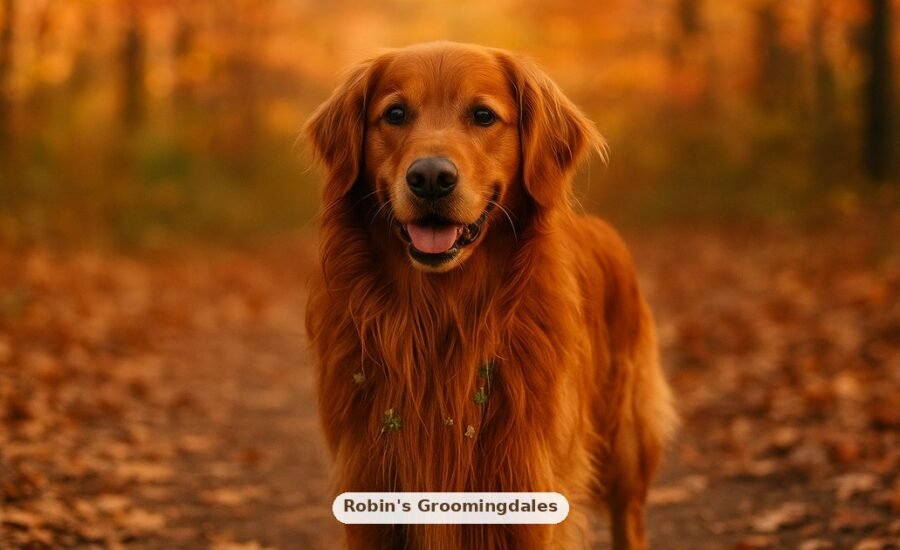
Fall is the best walking season Dunwoody gets. The humidity finally breaks, the trails at Brook Run Park and the Dunwoody Nature Center cool off, and dogs that spent August flopped on the porch want to be out again. Mocha, our golden retriever, is living proof. A fall loop at Brook Run usually sends him home with a dozen sticky green seeds packed into his chest feathering, a prickly knot behind one ear, and enough leaf litter in his coat to start a compost pile.
Golden coats like Mocha’s catch everything, but every dog picks up something this time of year. Keep walking. Just add a coat check when you get home, because fall trails send more home in the coat than summer ones do. Below is what hitchhikes back this time of year, how to find it in five minutes, and when it makes sense to hand the job to a groomer.
What Dogs Bring Home From Fall Walks in Dunwoody
Three things show up most after fall walks around Dunwoody: seed burrs from late-season weeds, spiky sweetgum balls and leaf debris, and ticks. Adult blacklegged ticks stay active through fall and into early spring on any day warm enough, so tick season in Georgia doesn’t end with summer.
Seed burrs are the most common find. By late September, the weeds along trail edges and fence lines have gone to seed, and plenty of those seeds are built to grab fur. Beggar’s lice, the small flat seeds that stick in neat rows, cover north Georgia fields this time of year. Cockleburs are bigger and hook in deeper. Sweetgum balls, which pile up on Dunwoody sidewalks every fall, don’t cling like burrs, but a long or curly coat can wrap around one after a good roll in the leaves. Ticks are the one find you can’t brush off and forget about.
How to Check Your Dog’s Coat After a Fall Walk
Run your hands through the coat before your dog comes inside. Fingers find burrs and ticks faster than eyes do, especially in a dark or dense coat. Go in the same order every time so nothing gets skipped:
- Ears, inside the flap and around the base
- Under the collar and along the neck
- Armpits and the groin
- Between the toes and around the paw pads
- Chest, belly, and any leg or tail feathering
- The base of the tail
The whole check takes about five minutes on a medium dog. Burrs collect where the coat is longest and where legs brush against brush: feathering, chest, and ears. Ticks go the other way. They crawl toward thin, warm skin, which is why the ears, armpits, groin, and toes matter most. A flea comb run slowly over those areas catches small ticks your fingers might miss.
How to Remove Burrs Without Cutting the Coat
Pull a burr straight out and it takes a clump of hair with it, usually with a yelp attached. Loosen it first. A little detangling spray or a dab of cooking oil on the burr helps the hooks slide. Then tease the hair away one small section at a time, working from the outside edge of the burr in, with your fingers or a wide-tooth comb. Big, dry cockleburs come apart more easily if you crush them gently with pliers first so the hooks break.
Keep scissors away from the skin. A burr pulls the skin up into a tent, and it’s easy to cut skin you can’t see under the hair. If a burr sits right against the skin or has already started a mat, leave it for a groomer with clippers and a steady table.
What to Do If You Find a Tick on Your Dog
Use fine-tipped tweezers or a tick-removal tool. Grab the tick as close to the skin as you can and pull straight up with slow, steady pressure. Don’t twist or jerk, and skip the old tricks like nail polish, petroleum jelly, or a hot match. They don’t make the tick let go any faster.
Clean the spot afterward and write down the date. Over the next few weeks, watch for lethargy, lameness, a poor appetite, or a fever, and call your vet if any of those show up. It’s also worth asking your vet whether your dog’s tick prevention should run year-round, since fall ticks catch a lot of owners who stop in September. Ticks also tend to turn up during a groom, at the bath and dry stage, which is one more reason a regular appointment helps in fall.
When a Groomer Saves You Time
Most post-walk finds are a quick fix at home. A few are easier to hand off:
- Dozens of beggar’s lice packed into leg or chest feathering
- Burrs that have started to form a mat
- Burrs between the toes or stuck to the paw pads
- A dog who won’t hold still for combing
Fall shedding makes all of this worse. Loose undercoat gives burrs and debris more to grab, and the two tangle together into mats fast. A bath and full brush-out after a busy stretch of trail walks clears it all at once, and a fall deshed treatment removes the loose undercoat before it has a chance to trap anything. If ticks are your bigger worry, our guide to the groomer’s role in flea and tick prevention covers what we look for.
Robin’s Groomingdales has served Dunwoody and Sandy Springs dogs since 1980. If your dog came home from the trail wearing half of it, book a bath and brush-out at our Jett Ferry Road salon or call (770) 396-8902.