
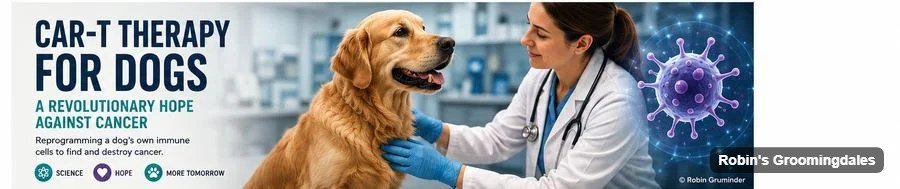
What if a dog’s own immune cells could be reprogrammed to recognize and attack its cancer?
That’s the idea behind CAR-T therapy, one of the most striking advances in modern immunotherapy. Already used in people against certain blood cancers, the technology is now being studied in dogs, including for B-cell lymphoma, osteosarcoma, and some brain tumors.
Canine CAR-T is still experimental. It isn’t a routine veterinary treatment today, and it’s available mainly through university clinical trials. Even so, recent progress has been significant enough to draw real attention in veterinary oncology.
What Is CAR-T Therapy?
CAR-T stands for Chimeric Antigen Receptor T-cell therapy.
T cells are immune cells that normally recognize and eliminate abnormal cells. The problem is that cancer cells develop ways to slip past that surveillance. CAR-T therapy is designed to get around that.
How Does It Work?
The process comes down to five steps.
- Collection. T cells are drawn from the dog’s blood (or from a donor).
- Genetic modification. In the lab, those T cells are engineered to display an artificial receptor called a CAR, built to recognize a target found on cancer cells.
- Multiplication. The modified cells are cultured until there are enough of them to work with.
- Administration. The CAR-T cells are given back to the dog under the trial’s protocol. Some trials also test injecting them directly into lymph nodes or into the tumor itself.
- Targeted attack. Once inside the body, the CAR-T cells can recognize their target, activate, and help destroy the cancer cells.
Think of it as an upgrade to the immune system’s own recognition software. The T cells get a new way to spot certain tumor cells they couldn’t reliably find before.

Which Canine Cancers Are Being Studied?
Research currently spans several cancer types.
B-cell lymphoma. This is probably the most advanced application of CAR-T in veterinary medicine. Lymphoma is one of the most commonly diagnosed cancers in dogs, and chemotherapy protocols like CHOP often achieve remission — but relapse is common. CAR-T aims to add a more targeted immune response against the tumor cells.
Osteosarcoma. This aggressive bone cancer mostly affects large-breed dogs. Research teams are studying modified immune cells that can recognize targets found in these tumors, including cases where the cancer has spread to the lungs.
Gliomas and brain tumors. Colorado State University is studying a CAR-T approach for canine gliomas, paired in its trial protocol with verdinexor. In this trial, some of the CAR-T cells are delivered directly into the tumor.
Other solid tumors. Experimental work is also exploring different tumor antigens, including B7-H3. This is a particularly hard problem, since solid tumors are a much bigger challenge for CAR-T than blood cancers are.
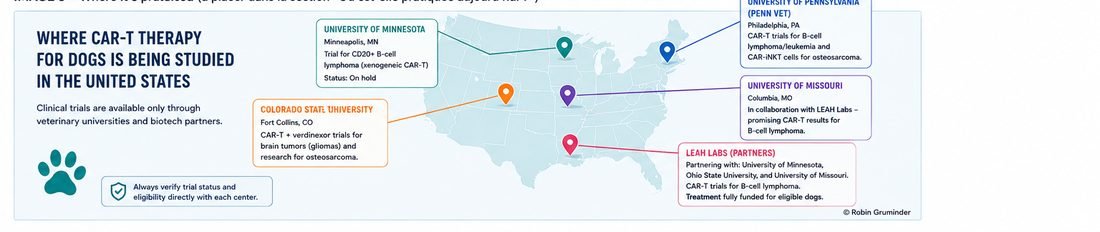
Where Are CAR-T Trials for Dogs Available in the US?
The landscape changes quickly — a trial’s status can shift from “recruiting” to “on hold” or “completed” with little notice, so always confirm directly with the center before making travel plans.
University of Pennsylvania (Penn Vet) — Philadelphia, PA. One of the leading US centers for comparative immunotherapy research. Dr. Nicola Mason’s team has worked for years on CAR-T in dogs with naturally occurring cancers, including cellular immunotherapy against B-cell lymphoma/leukemia and CAR-iNKT cells for metastatic osteosarcoma. Learn more: Penn Vet Comparative Immunotherapy Program.
LEAH Labs — a biotech company focused on cellular therapies for companion animals. LEAH Labs reports remissions in dogs treated with CAR-T and is developing a next generation of treatments. Its 2026 B-cell lymphoma program is announced with three partner institutions: University of Minnesota, Ohio State University, and University of Missouri. LEAH Labs states that treatment is fully funded for selected dogs. Learn more: leahlabs.com.
University of Minnesota — Minneapolis, MN. Studying CAR-T against CD20+ B-cell lymphoma, with cell administration into multiple lymph nodes. This particular trial’s page currently lists its status as “on hold” — that doesn’t rule out other programs or new industry-partnered recruitment, so check directly with the center. Learn more: University of Minnesota trial page.
Colorado State University — Fort Collins, CO. Running a trial combining CAR-T with verdinexor for dogs with brain glioma; dogs need an MRI-identified, surgically accessible tumor for biopsy and cell delivery. CSU also lists CAR-T work related to osteosarcoma. Learn more: Colorado State clinical trials.
University of Missouri — Columbia, MO. Working with LEAH Labs, with promising CAR-T results reported for B-cell lymphoma.
And in Georgia?
For owners in Atlanta, Dunwoody, or elsewhere in Georgia, the closest starting point is the University of Georgia College of Veterinary Medicine (UGA) in Athens. UGA has a veterinary oncology service and participates in clinical trials — in 2026 it lists an open trial for dogs newly diagnosed with large B-cell lymphoma. That particular trial is an experimental oral product, not a CAR-T therapy. Still, UGA is a strong place to start for an accurate oncology diagnosis and a conversation about which trials elsewhere in the US might be a fit. Learn more: UGA clinical trials.
Why Are Dogs So Important to This Research?
This might be the most fascinating part of the story. Pet dogs develop cancer naturally, they share our environment, they have a fully functional immune system, and they carry far more genetic diversity than traditional lab models. Some canine cancers are also biologically similar to their human counterparts.
This field is called comparative oncology. Veterinarians, biologists, and physicians can study new therapies in dogs that already have cancer, working to help the dogs themselves while also gathering knowledge that can inform human cancer research. The benefit runs in both directions — from human medicine to veterinary medicine, and from dogs back to humans.
Does This Mean a Cure Is Coming Soon?
It’s worth staying cautious. CAR-T has produced remarkable results in certain human diseases, but those results don’t automatically translate to dogs. Open questions in canine CAR-T include how long the modified cells persist, which tumor targets work best, effectiveness against solid tumors, the risk of immune reactions and toxicity, the chance of relapse, and the cost and complexity of manufacturing a treatment fast enough for an aggressive cancer. Current research is working through exactly these questions.
What Does CAR-T Therapy for a Dog Cost?
There’s no standard “CAR-T price” yet, since it isn’t a routine commercial treatment. Some clinical trials cover a large share — sometimes all — of expenses directly tied to the study. But owners should plan for costs that may fall outside the protocol: travel to the university center, lodging, tests outside the study, care for unrelated conditions, and any complications not covered by the trial. Always ask the trial coordinator exactly what’s funded before enrolling.
My Dog Has Cancer — How Do I Look for a CAR-T Trial?
- Get a precise diagnosis. “Cancer” or even “lymphoma” isn’t specific enough — research centers need the exact tumor type, stage, test results, and prior treatments.
- See a veterinary oncologist. They can help determine whether a trial is a reasonable option and can send the medical record to researchers.
- Search current trials. The Veterinary Clinical Trials Registry lists studies across the US.
- Contact centers directly. Don’t wait for a trial to be offered — reach out and ask if your dog fits the inclusion criteria. Have ready: diagnosis and biopsy/cytology report, age and weight, breed, diagnosis date, prior treatments, imaging results, and current medications.
Still Experimental, But Genuinely Promising
A few years ago, the idea of collecting a dog’s immune cells, modifying them genetically, and using them as a living medicine against cancer sounded like science fiction. Today, dogs are actually enrolled in CAR-T trials across the US.
That doesn’t mean CAR-T will replace chemotherapy, surgery, or radiation therapy any time soon — those treatments remain essential and have far more clinical track record behind them. But a new path is now open. And maybe the most remarkable part of this research is this: in looking for better ways to treat cancer in dogs, researchers may also be finding better ways to treat it in people.
This article is informational. CAR-T therapy for dogs is experimental. Nothing here replaces the advice of a veterinarian or veterinary oncologist, and clinical trial status and eligibility can change quickly — always verify directly with the trial center. Updated August 2026.
Whatever your dog is going through — a routine groom or a tougher season like this one — the Robin’s Groomingdales team is happy to help however we can.